Capoeira can serve as a form of psychological and perhaps even spiritual resistance against many different forms of oppression – the embodiment of joy.
By Lauren Miller Crawford.
When we say that capoeira is an art of resistance, what is it that we really mean? When I initially encountered capoeira, this was presented to me in a very literal way: enslaved Africans used capoeira as a means of surviving and hopefully escaping from captivity. It’s a great story, but so are most martial arts myths. Here I am using the word myth in its anthropological sense, as a structuring story that gives shape to a community’s values and institutions rather than as something inherently false. As I began working on my most recent monograph—Graceful Resistance—I began to earnestly question this position. There are certainly capoeiristas who I wouldn’t want to run afoul of because they know how to use their art in an efficacious manner, but that’s not me. My capoeira wouldn’t save me from much of anything…at least not physically. To me, capoeira is a form of self-expression, a never-ending puzzle we nonetheless try to solve, and the embodiment of joy. This is where I see its potential as a form of resistance. Under the right conditions, capoeira can serve as a form of psychological and perhaps even spiritual resistance against many different forms of oppression.
A decade ago, I had just started a new research project when the young man I was interviewing sent me off in a totally new direction. I asked about the demographics of his group, and I was expecting for him to tell me how many people were in their group, their relative ages, the racial composition of the group, the male to female ratio, etc. Instead, he surprised me by saying there are no all lives matter folk in the roda. I instantly knew what he meant, though I had never given it much thought up to that point. I often joke that I’ve yet to meet a white nationalist capoeira group (at least here in the U.S.), but if I ever do, I’d be very interested in studying them because it is not the norm. Most groups I have encountered are explicitly pro-Black. I attribute this in large part to the fact that information about capoeira’s colonial history and the abuses therein have been transmitted alongside the physical and musical components of the art. And of course, the role of music here is very important, provided that capoeiristas outside of Brazil understand the Portuguese lyrics. The songs are an important vehicle of this history. Unlike many other arts such as Brazilian jiu-jitsu, capoeiristas are steeped in Brazilian culture and history from very early on in their training. But when my interlocutor made this comment about “all lives matter folk,” I realized there was more to the capoeirista’s ideological commitments than I had previously thought.
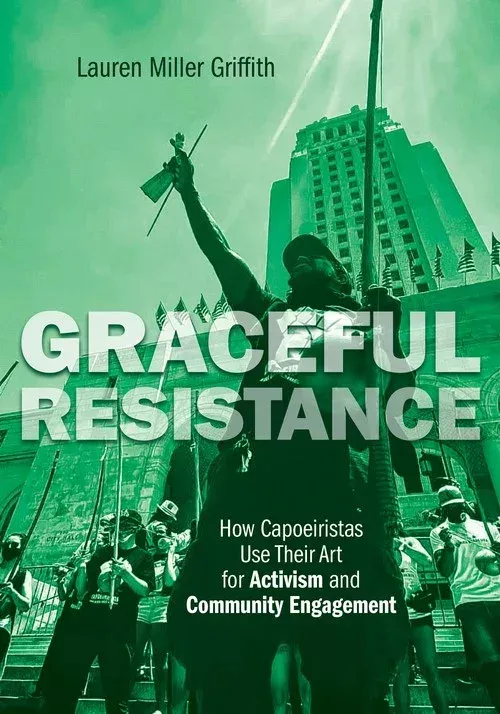
My 2023 book, Graceful Resistance, was the ultimate result of the research his comment led me to. This book is based on nearly 40 interviews focused on capoeira and social justice, which augments the 30 or so interviews I conducted for my first book and many years’ worth of participant observation. It is a detailed exploration of how capoeira can become a catalyst for community engagement and social activism. I conclude that enculturation into this community of practice attunes one’s affective responses in a precise and predictable manner.
These affects become channeled into concrete forms of performative resistance. Here is it important to note that I am using the word performative much like Austin and Butler, as acts that alter social reality, not in the popular sense of an act being empty or just for show. Performative resistance can refer to any number of embodied actions undertaken artfully to call attention to and oppose oppressive structures and situations. Sometimes these will take place within the context of organized social protests, but they may also take place in more mundane settings. One of my larger points is that becoming a capoeiristas is about more than learning some cool moves. It fundamentally alters the way one walks in the world, and becoming part of this leisure community is actually quite serious.
For context, the research I did for this project took place in the United States, and while I have done research in Brazil, I cannot speak to the ideological commitments of most Brazilian groups as my engagements were limited to one franchise that is known for its alignment with Black politics. As I reflected on my interlocutor’s comment, I wondered how widely his observation might apply. Rather than limiting myself to looking at capoeiristas’ support of Black political movements, I expanded my gaze to include all forms of social justice advocacy in the United States. I easily found it in the places I expected such as large metropolitan areas, particularly along the coasts, and college towns nationwide. But I also found it in places where I hadn’t expected it such as rural communities in the Midwest and South, which are traditionally conservative communities with right-leaning politics.
I met people who organized clothing drives to help unhoused people dress well for job interviews, people who debated changing groups because they couldn’t get their mestre onboard with doing more outreach in the poorer parts of the city, and people who organized large-scale marches to protest bullying and police brutality. I talked to group leaders who structured their classes to teach students about social justice, environmental activism, and personal growth. And I met people who used capoeira in therapeutic settings. After speaking with so many peoplemoremore than 30 interviews, I was truly humbled by the good work being done by this community. I had to ask myself, does capoeira just attract good people, or is there something about this community that impels people to try and make the world a better place?
I believe it is a little bit of both. I am also fully aware that my own bias is showing here, and there may be readers among you who do not think that protesting after an officer-involved shooting is a good thing or that it is our place to do outreach in poor communities when capoeira schools are often operating on shoestring budgets. These are completely valid positions. I am merely pointing out that in my research social justice focused activism is widely considered a good thing.
I believe that the origin story is the first litmus test for an individual’s acclimatization to this community. People who don’t believe in the resistance narrative largely disappear from the capoeira community. Those who remain in the community begin a process of enculturation that instills in them what I have come to call the capoeirista’s affective habitus.
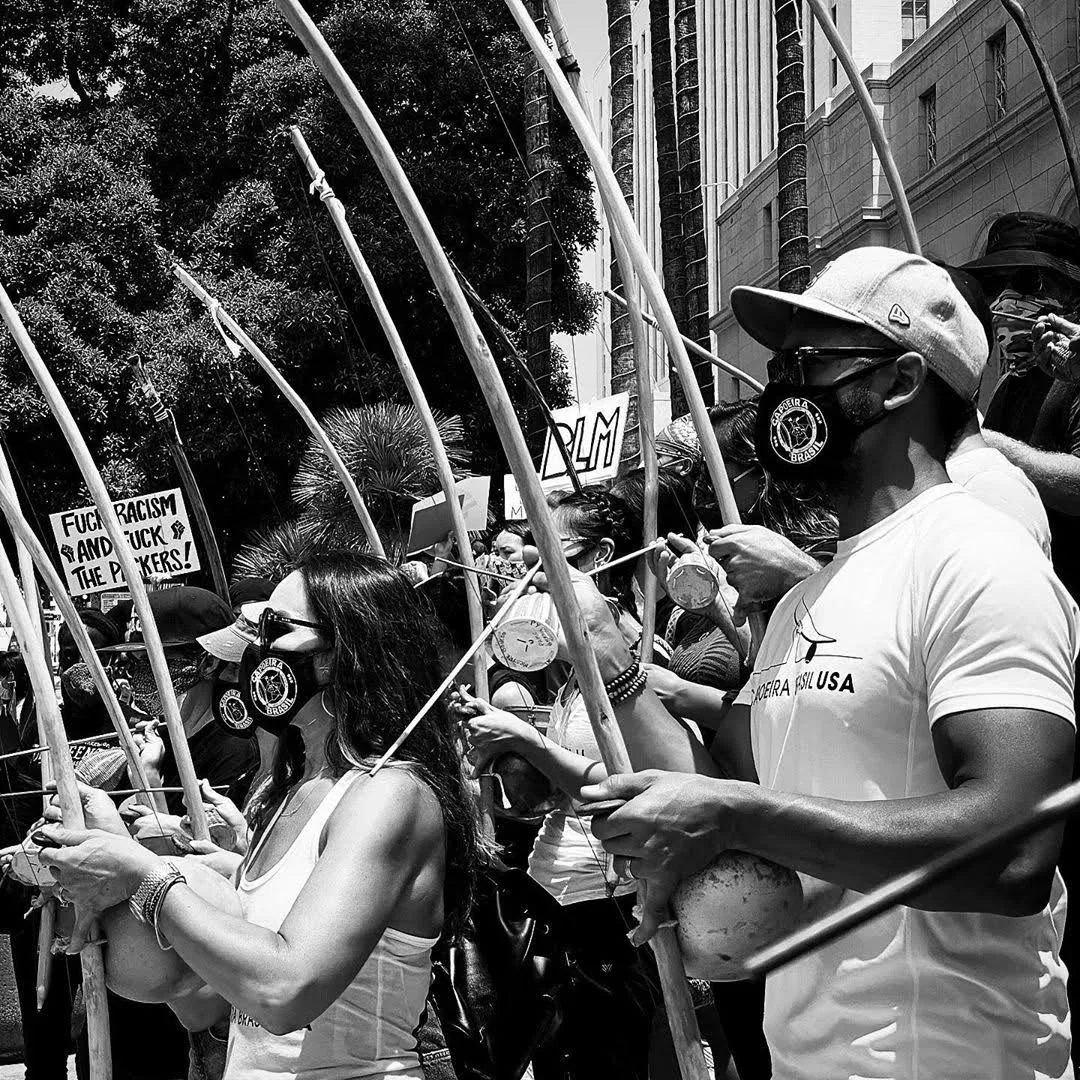
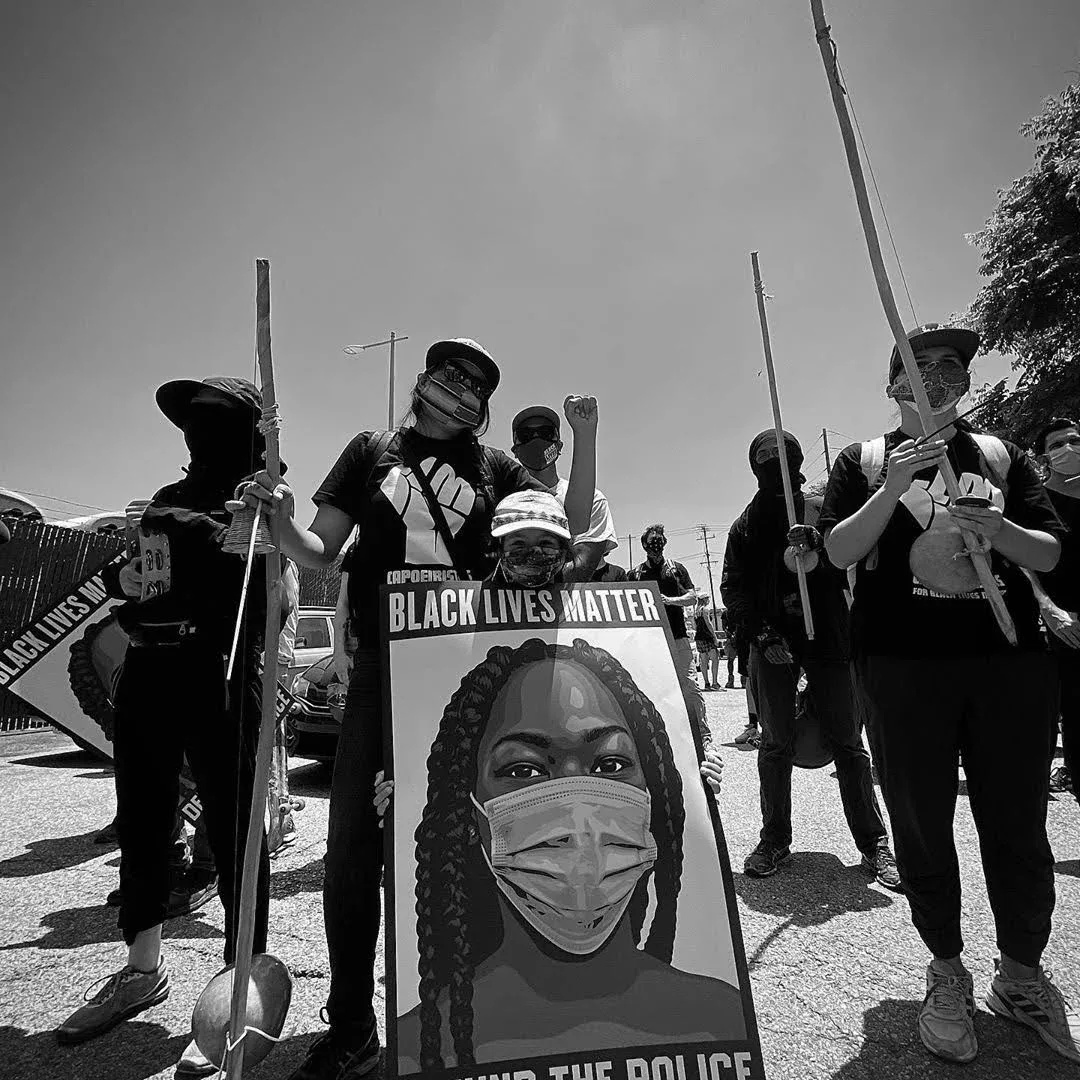
At the end of a march in support of the #BLM movement, capoeiristas bring joy to their community with a roda, graceful resistance in action.
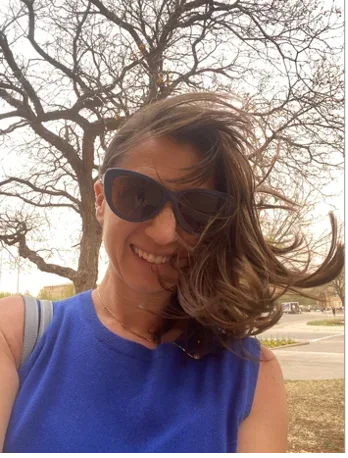
Lauren Miller Crawford, Ph.D., is an associate professor of anthropology at Texas Tech University. Her forthcoming book with Palgrave is a speculative ethnography written in an interactive fiction style designed to interrogate the concept of agency and the ambiguities of sexual violence within hierarchical social fields. Currently, Lauren is working on questions related to how recovering from trauma affects’ practitioners abilities to participate in Brazilian Jiu-Jitsu.
Bibliography
Austin, John. L. How to do things with words. Oxford: Oxford University Press, 1962.
Bourdieu, Pierre. (1980) The logic of practice. Translated by R. Nice. Stanford: Stanford University Press, 1990.
Butler, J. Gender trouble: Feminism and the subversion of identity. New York: Routledge, 1990.
Downey, G. Learning capoeira: Lessons in cunning from an Afro-Brazilian art. Oxford: Oxford University Press, 2005.
Griffith, Lauren Miller. Graceful resistence. How apoeiristas use ther art for activism and community engagement. Champaign: University of Illinois Press, 2023.
Mauss, M. “Techniques of the body” (trad. B. Brewster). Economy and Society 2, n.1 (1973): 70–88. https://doi.org/10.1080/03085147300000003
Sánchez García, R., e D. C. Spencer, eds. Fighting scholars: Habitus and ethnographies of martial arts and combat sports. New Yorque: Anthem Press, 2013.
Scott, J. C. Weapons of the weak: Everyday forms of peasant resistance. New Haven: Yale University Press, 1985.
Wacquant, L. Body and soul: Notebooks of an apprentice boxer. Oxford: Oxford University Press, 2004.