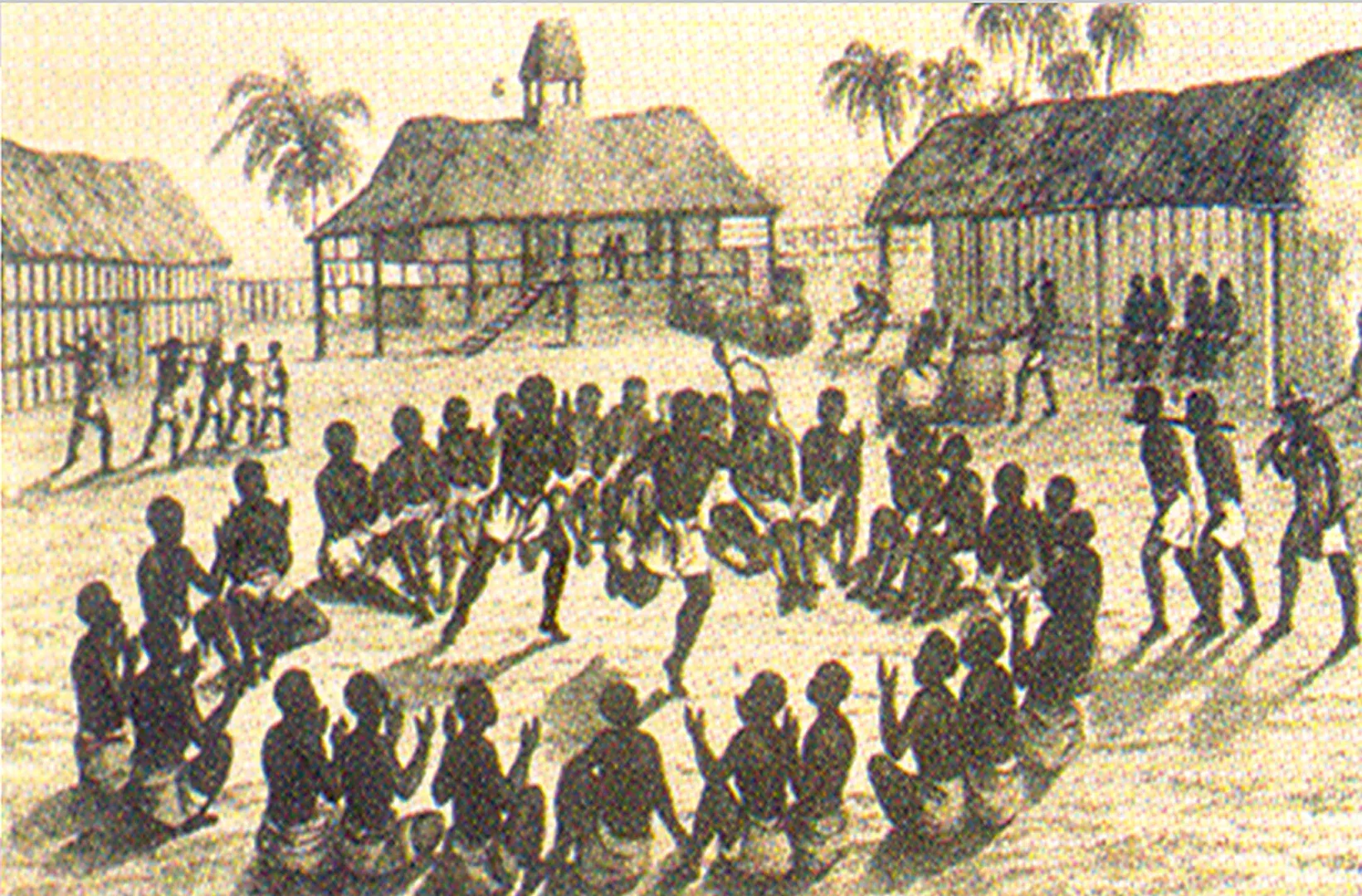
An anonymous image of the region of the former kingdom of Loango, completed in 1826, shows Africans coming from the interior of the Congo, before embarking for America.
By Carlos Eugênio Líbano Soares.
In 2008, I was in Paris researching African slavery in the 18th century and looked through hundreds of images at the François Mitterrand National Library of France. I came across this (anonymous) image of the region of the former Kingdom of Loango, supposedly from 1826, which intrigued me greatly.
In it, we see the barracks where Africans were kept, which had been brought along the so-called Vili routes – coming from the interior of the Congo, arriving at the mouth of the River Zaire, south of the Kingdom of Loango –, before being shipped to the Americas (mainly the Caribbean). In the foreground, we see the circle where African slaves who had been in the barracks for some time gathered as usual. These Africans were of diverse ethnicities, from the region referred to as Northern Congo by Mary Karasch, and mapped in Westerman’s 1948 book.1 We also see, crossing the area in the background, those new arrivals with the ‘cangalha’ (a Kimbundu word for chain).
1 Karasch, Slave Life; Westermann, The missionary.
According to the general theory put forward by Richard Price and Sidney Mintz, Africans captured and dispersed across the diaspora had marked ethnic and political differences, even when they came from regions with a high degree of linguistic and cultural homogeneity, such as West-Central Africa2 . However, the common cultural background, despite having been buried by centuries of cultural diversification, is reawakened at this moment of forced union through slavery, becoming important for cementing political alliances.
This is what Robert Slenes argues when he elaborates on the concept of Bantu proto-nation. The Bantu cultural background would prove strategic for Africans in the diaspora, including during moments of confronting enslavers’ violence, such as at Palmares. According to Slenes, Africans from deep within Central Africa communicated easily with others inhabiting the coast occupied by Europeans. Ethnic rivalries lost their meaning in this new situation, and the bonds of unity, such as intangible culture and language, became more important for survival.3
2 Mintz, e Price, O nascimento da cultura.
3 Slenes, “Malungo n’goma”.
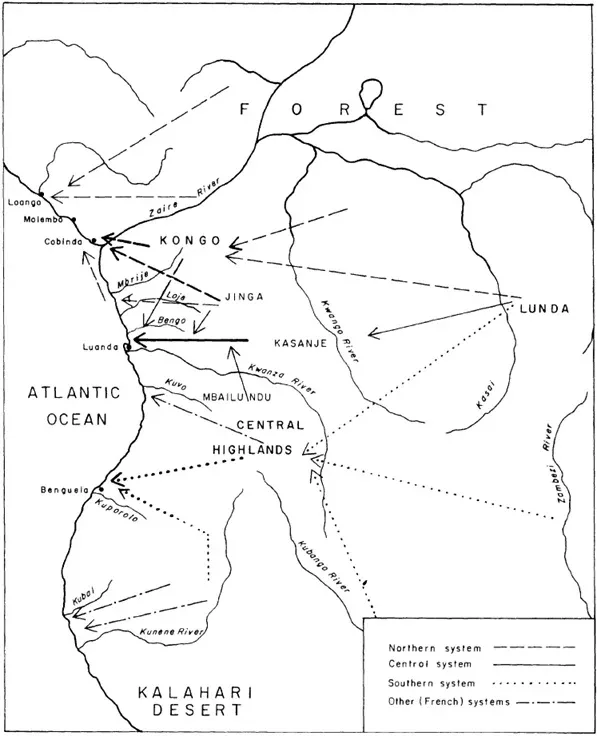
“Central-Western Africa in the 18th Century (Geography and Scheme of Slave Trade Networks).” Map sketch published by Joseph Miller.
In the scene depicted, the figures are sitting in a circle, or what the anthropologist Wyatt MacGaffey termed a ‘counter-clockwise circle’, another common feature among Bantu-speaking peoples.4 There is a sense of homogeneity within this circle, strictly speaking, and no distinctive signs of ethnic difference. Yet within the circle, one pair stands out.
We see two individuals vying for leadership. One of them, in a defensive stance on the left, appears to be waiting for the blow. The fighter on the right wields what appears to be a club and prepares to strike his opponent. Certainly, the contest, even if simulated, represents a struggle for prestige within a group that will likely remain united, at least for the duration of the next slave ship.
According to Janguinda Kambuwetete Kabwenha’s book, the Africans of Angola have preserved various forms of martial arts of immemorial origin, which were certainly found on the other side of the Atlantic. 5 But we are interested in the African side of the Atlantic now.
In the scene depicted in the painting, the two individuals vie for leadership through an improvised martial art, which may be a mixture of different practices, but which resembles kambangula, practised today in central and south-western Angola, as shown on Kabwenha’s own map.6 Similarly, the contest for leadership is a structural feature of capoeira, both in the past and in the present.
Africans from what is now Angola may have been trafficked along the Vili routes, but what is significant about the engraving is that the posture of those depicted shows the formation of a community—the slave-hip community—doomed to be broken up upon arrival in America, yet one that would have an impact on the lives of Africans in the ‘land of the white man’, as they called it in Bahia, according to João José Reis.7 A remnant of the enduring nature of these ties is the term ‘Malungo’—meaning slave shipmate—which became an important part of the African lexicon in the Americas, within the context of personal relationships, both during and after the era of slavery.
4 MacGaffey, Religion and Society.
5 Kabwenha, Artes marciais de Angola.
6 Kabwenha, Artes marciais de Angola, 137.
7 Reis e Silva, Negociação e conflito.
At the beginning of the 19th century, Rugendas and Debret recorded two scenes of the slave trade, an activity concentrated in the Valongo Wharf (port area of Rio de Janeiro).
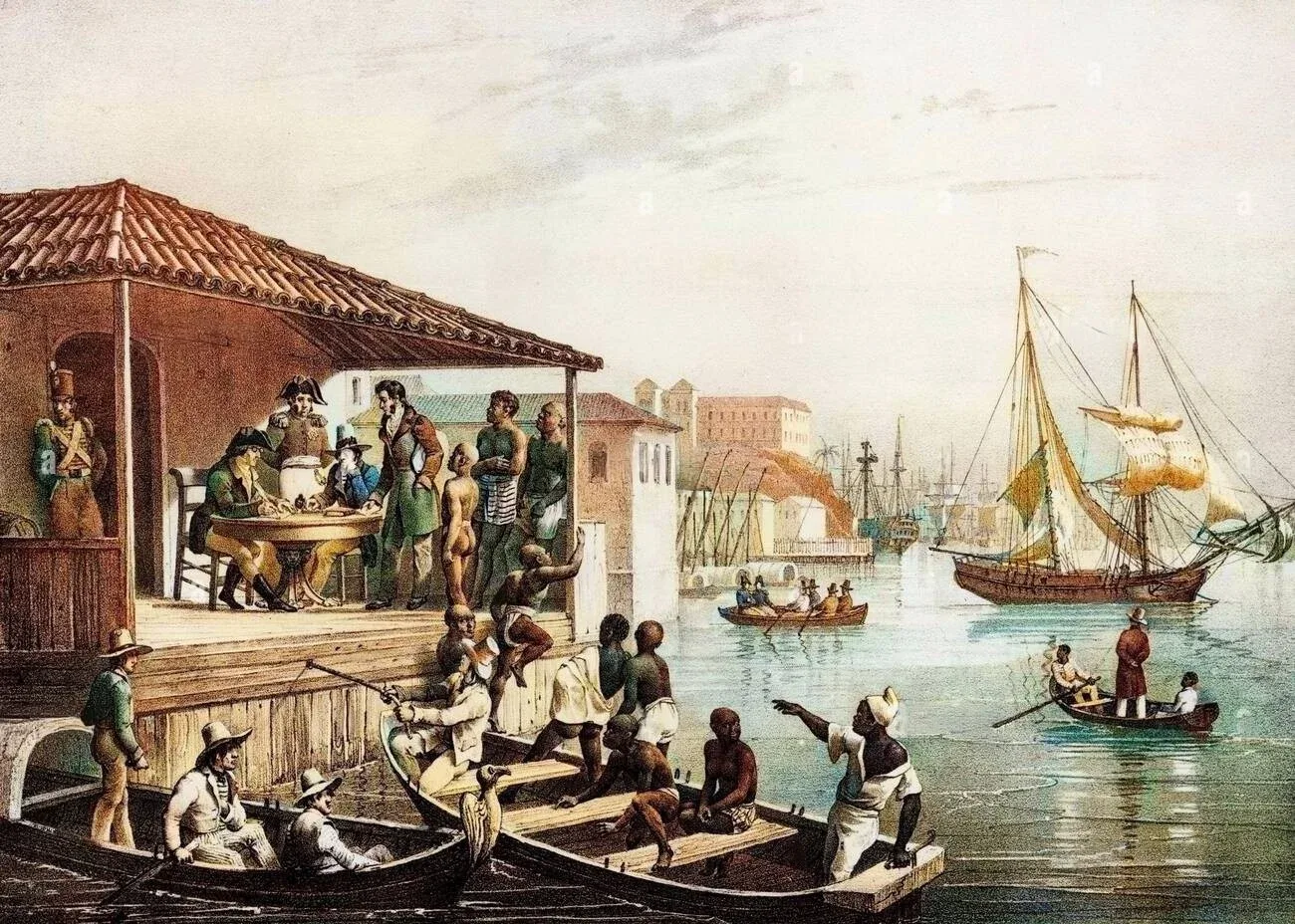
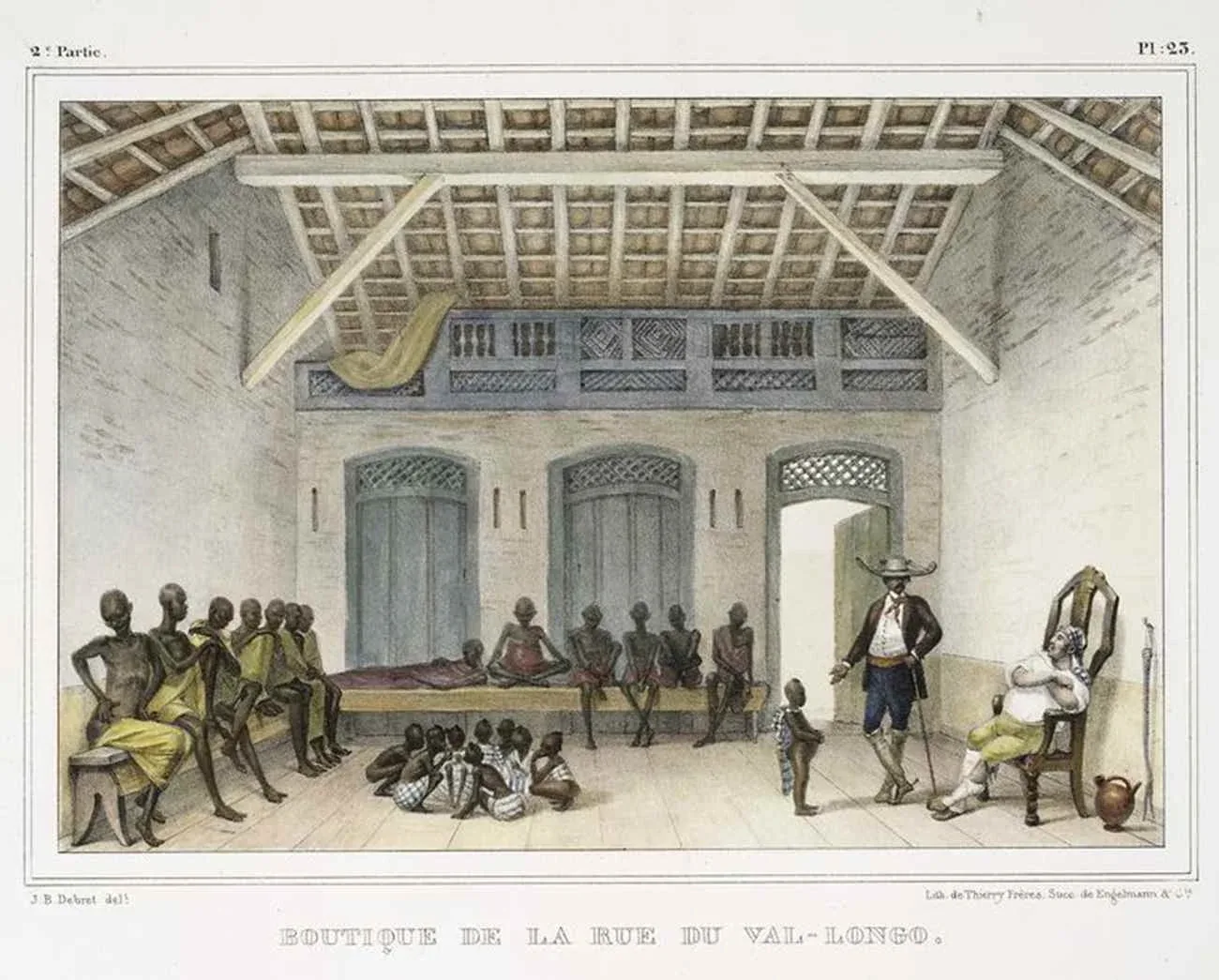
Freireyss personally encountered hundreds of naked slaves of both sexes and of all ages who danced in a large circle while they clapped their hands and shouted a song of only three notes. One dancer would leave the circle and go to the center, ‘moving the body in all drections’, and when he finished, another would take his place. At times such a dance laster for hours, much to the displeasure of the neighbourhood residents”.9Capoeira, according to our hypothesis, like almost everything in the African culture of the diaspora, emerged from the combination of various ceremonial dances and martial arts that existed across the vast region where slaves were captured. We believe that the combination of these practices gave rise to something new yet multifaceted, as was the case with capoeira in Brazil and also with ladjya in Martinique. The image illustrates what Bob Slenes describes in his seminal text as the formation of African-American culture, beginning with the capture of individuals in the heart of Africa and the gathering of these people, from different cultures and ethnicities, yet united by language.10 The painting depicts a rare scene and illustrates the emerging culture of slavery amongst those torn from their homes by violence, whilst still on African soil. This engraving captures a crucial moment in the formation of slave culture in the Americas: when the community on the slave ship ‘replaces’ ethnicity—a concept we must, of course, view in relative terms. The engraving dates from the 19th century, a time when much of the slave trade was clandestine and French ships were able to supply the illegal trade. Further research is needed to better contextualise this important iconographic document.
8 Karasch, Slave Life, 80-81.
9 Karasck, Slave life, 81.
10 The languages spoken by the peoples of the Kongo region were related, almost all from the Bantu linguistic family. This linguistic proximity did not exist in West Africa.
Carlos Eugênio Líbano Soares holds a doctorate in Social History of Labor from Unicamp and a post-doctorate from the Federal University of Rio de Janeiro. He is currently an adjunct professor at the Federal University of Bahia and an associate professor at the Federal Rural University of Rio de Janeiro. His research focuses on the history of African slavery, with an emphasis on the history of urban slavery in Rio de Janeiro and Salvadorr.

References
Kabwenha, Janguinda Kambwetete. Artes marciais de Angola: akwa mawta – clássico de honra. S.l: Yakalakaya, 2024.
Karasch, Mary C. Slave Life in Rio de Janeiro, 1808-1850. Princeton: Princeton University Press, 1987.
MacGaffey, Wyatt. Religion and Society in Central Africa: the Bakongo of Lower Zaire. Chicago: University Chicago Press, 1970.
Mintz, Sidney W. e Richard Price. O nascimento da cultura afro-americana: uma perspectiva antropológica. Rio de Janeiro: Pallas e Universidade Cândido Mendes, 2003.
Reis, João José, e Eduardo Silva. Negociação e conflito. A resistência negra no Brasil escravista. São Paulo: Companhia das Letras, 1989.
Slenes, Robert W. “Malungo n’goma vem: África encoberta e descoberta no Brasil”. In: Mostra do Redescobrimento: Negro de Corpo e Alma – Black in Body and Soul. (Catálogo da exposição realizada de 23 de abril a 7 de setembro de 2000 no Parque Ibirapuera, São Paulo). Nelson Aguilar, org. São Paulo, Fundação Bienal de São Paulo/Associação Brasil 500 Anos Artes Visuais, 2000, 212-220.
Westermann, Diedrich H. The missionary and anthropological research. Oxford University Press for the International African Institute, 1948.
Miller’s map was published in “África central durante a era do comércio de escravos de 1490 a 1850”. In Diáspora negra no Brasil, Heywood, edited by Linda M. São Paulo: Contexto, 2008.
Debret’s image is part of the collection of the Biblioteca Nacional (Rio de Janeiro).
Rugendas’ image was published in Voyage. Voyage Pittoresque et historique au Brésil depuis 1816 jusquen 1821.