An exploration of the relationship between taekkyeon and music in broader terms, considering musicality as a bodily, acoustic, and social dimension.
By Martin Minarik.
In his recent blog article “Martial arts and music: A comparison of Muay Thai, Pencak Silat, Capoeira and Taekkyeon”, Néstor Vega González (2025)compares the relationship between movement and music in Muay Thai, Pencak Silat, capoeira, and Taekkyeon, with particular attention to contexts of practice and performance. Regarding Taekkyeon, he notes that live musical accompaniment does not normally structure the direct exchange between practitioners. In this respect, contemporary Taekkyeon differs from practices such as capoeira and from contexts in which music more directly accompanies or organizes martial interaction. In Taekkyeon, music is more commonly encountered in competitions, demonstrations, and choreographed performances than in the bout itself.
The present contribution takes this observation as its point of departure but approaches the relationship between Taekkyeon and music in broader terms. Rather than asking only whether instrumental music accompanies practice, it considers musicality as an embodied, acoustic, and social dimension of Taekkyeon. Rhythm is generated through bodily movement and coordination; breathing and vocalization add an auditory dimension; and spectators, calls, percussion, and other sounds contribute to the acoustic environment of the pan (판), understood here as the social and performative space in which Taekkyeon takes place as a communal event. In some contemporary performance and heritage contexts, Taekkyeon is also combined with traditions such as pungmul (풍물), a Korean folk-performance tradition incorporating percussion, movement, dance, and communal participation. Such combinations further foreground the aesthetic and performative dimensions of Taekkyeon.
These characteristics, however, should not be projected backwards as timeless features of the practice. Modern Taekkyeon was substantially systematised and differentiated during the twentieth century, and its movement vocabularies, terminology, forms, competition rules, pedagogical practices, and institutional identities were shaped by different practitioners and organisations. This process is particularly visible in the three organisations that came to represent major institutional strands of contemporary Taekkyeon: the Korea Taekkyon Federation (대한택견회), the Korea Taekkyeon Association (한국택견협회), and the Kyulyun Taekyun Association (결련택견협회). Widae Taekkyeon (윗대태껸) emerged more recently as a distinct institutional current and has so far played a more limited role in shaping the broader public representation of Taekkyeon. Consequently, rhythm, vocalisation, and musical performance are better examined as historically and institutionally variable features of Taekkyeon than as inherent properties of an unchanged tradition.
Historical Taekkyeon and Music
The extant historical evidence does not demonstrate that music regularly governed Taekkyeon contests. Foreign accounts from the late nineteenth century provide predominantly descriptive accounts of Taekkyeon, characterising it as a game or form of martial practice. In Stewart Culin’s Korean Games (1895), for instance, Culin describes two players who primarily use their feet to attack while also employing their hands to catch higher kicks. He also describes attempts to throw or knock opponents down. Kim and Shim’s (2014) survey of foreign descriptions from the late Joseon period likewise identifies accounts of Taekkyeon as children’s play, adult combat, competitive fighting, and martial activity. None of these sources provides a detailed account of musicians controlling the contest.
A similar pattern is found in Korean descriptions from the late Joseon and colonial periods. Taekkyeon is described as a contest, a game, a physical confrontation, or a local fighting practice. Later sources also preserve memories of gambling, neighbourhood rivalry, and connections with socially diverse groups. As Kim and Sim (2018) show, the sources refer to children; walja (왈자), members of a late-Joseon urban subculture associated with leisure, entertainment, bravado, and sometimes violence; military and policing milieus; and contests involving money. While some of their stronger claims concerning formal military use remain speculative, the evidence suggests a socially heterogeneous urban combat culture rather than a specialised artistic performance tradition.
This does not imply that music was absent from Taekkyeon activities. A competition held during a festival or community gathering may have shared its space with music, food, spectators, and other forms of entertainment. Although stable historical arrangements in which musical rhythm determined the timing or character of Taekkyeon exchanges cannot be demonstrated, modern Taekkyeon is often described in strongly aesthetic terms. UNESCO, for example, describes it in terms of “fluid, rhythmic dance-like movements” (UNESCO, 2011). Such descriptions reflect contemporary presentations of Taekkyeon but should not automatically be treated as descriptions of nineteenth-century practice.
The Rhythm of Moving Bodies
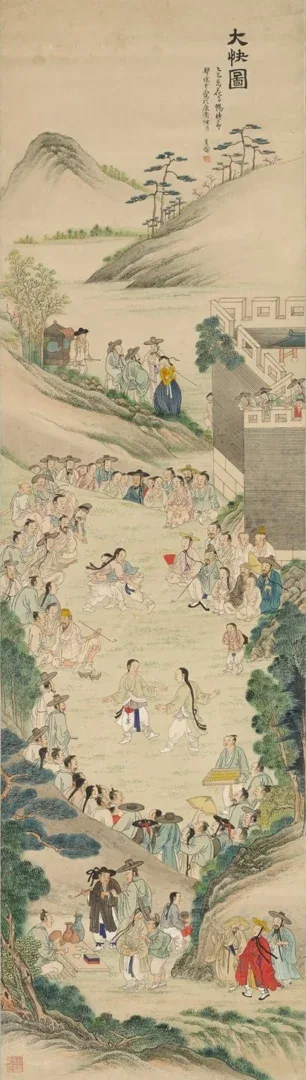
The most evident connection between Taekkyeon and musicality is found in bodily rhythm, particularly in pumbapgi (품밟기), the stepping and weight-shifting practices that have become one of the most recognisable features of modern Taekkyeon.
Taekkyeon is frequently described as following a three-beat rhythm. However, comparative research reveals a more complex picture.
In a comparative study, Kim and Kim (2014a) examined the movement routes and terminology of pumbapgi in the main contemporary Taekkyeon organisations. They identified substantial differences. The organisations employ a variety of movement routes, including triangular, inverted triangular, straight, diamond-shaped, and zigzag patterns, among others. The Daehan tradition, for instance, places particular emphasis on an inverted triangular motif, while Widae-related practice is described through different concepts and movement logics. These differences complicate the idea of a single Taekkyeon “musical rhythm”. The three-beat pattern is significant in modern Taekkyeon, yet it is not the only rhythmic possibility. Even where the pattern varies, rhythmic movement remains a recurring feature of practice. Kyulyun, in particular, places considerable emphasis on rhythmic exercises in everyday practice, including warm-up drills and prescribed partner exercises designed to synchronise collective and dialogical movement.
An example of shared rhythm in Kyulyun practice.
Source: Monkey Steals Peach YouTube channel, 2018.
Competition rules also shape these differences. Kim and Kim (2014b) relate different forms of stepping to a range of tactical objectives. Kyulyun emphasises lower-body exchanges, whereas the Daehan system has developed in response to different competitive requirements, including push kicks and restrictions on impact in low kicks. These differences are reflected in their respective forms of pumbapgi.
Taekkyeon’s musicality lies less in a fixed three-beat metre than in rhythm as a practical principle of movement. Rhythmic patterns vary across organisations and are shaped by partner coordination, tactical aims, and competition rules. In Kyulyun especially, rhythm structures collective drills and lower-body exchanges, showing that Taekkyeon’s rhythmicity is functional and adaptive rather than tied to a single fixed pattern.
Voice, Breath, and Kihap
In Taekkyeon, voice, breath, and kihap (기합), or the “martial yell”, are equally instrumental in the production of musicality.
Kim, Kim, and Lee (2011) examine the functions of kihap in Taekkyeon. Their interpretation encompasses physiological and combative functions, including breathing, exertion, concentration, and interaction with an opponent. They also describe vocalisation in relation to jangdan (장단), a concept from traditional Korean musical theory that refers to recurring rhythmic cycles in traditional Korean music. In Daehan and Hanguk Taekkyeon, recurring kihap vocalisations such as “ikeu” and “ekeu” (이크/에크) typically accompany stepping, collective form practice, and partner exercises, helping practitioners maintain a shared rhythm and coordinate their movements.
The rhythmic ikeu/ekeu calls used in contemporary Daehan and Hanguk Taekkyeon should be distinguished from earlier vocal practices. Recollections of Song Deok-gi (1893–1987), a central figure in transmitting Taekkyeon from late Joseon Korea into the twentieth century, describe short calls such as ik or iik used during exertion or to alert a partner to an impending attack, without the alternating ekeu pattern (Gong, 2012, pp. 54–55). The modern pairing may therefore be understood as a rhythmic regularisation of earlier vocalisations, potentially serving pedagogical purposes by coordinating breath, movement, and collective timing.
Voice and breath thus make bodily effort audible while shaping the timing of movement and interaction. From situational calls to recurring vocal patterns, kihap contributes to Taekkyeon’s musicality as an embodied, acoustic, and social dimension of practice whose forms change through transmission and teaching.
The Acoustic Ecology of the Taekkyeon Pan
The role of music becomes more apparent when Taekkyeon is considered within a performative space, or pan (판), rather than only as a technical exchange.
The historical term gyeollyeon taekkyeon (결련태껸) is particularly relevant. Kim and Choi (2020) cite a 1938 dictionary definition in which two neighbourhoods form opposing sides and compete in Taekkyeon. They place this practice within a broader Seoul culture of collective contests such as Seokjeon (석전, stone fighting) and other forms of Pyeonssaum (편싸움, group contests). Their broader reconstruction contains some interpretive claims that require caution, but the evidence supports the existence of locally organised group competition.
In such a context, the pan is more than the surface on which two fighters stand. It includes competitors, teammates, spectators, calls, reactions, and the atmosphere surrounding the contest.
This remains visible in contemporary Kyulyun Taekyun. Do, Won, and Jo (2013) describe Kyulyun as a communal and participatory form in which fighting, spectatorship, team identity, improvisation, and pungryu (풍류) intersect. Pungryu is a broad Korean cultural-aesthetic concept that resists straightforward translation; it may refer to the cultivated or pleasurable enjoyment of art, music, nature, sociability, and leisure, as well as more generally to an atmosphere of free-spirited enjoyment, aesthetic play, conviviality, and artistic expression. Their account also reflects the self-understanding of the modern Kyulyun organisation and should be read with that in mind. In the modern Taekyun Battle, which can be understood as a contemporary reinterpretation of historical gyeollyeon taekkyeon, music contributes primarily to the event’s broader soundscape and atmosphere rather than structuring the fight itself. Samul Nori (a modern systematisation of Korean farmers’ music) accompanies the teams as they enter the competition area, and when a new challenger steps onto the floor, a short, often improvised solo performance is likewise accompanied by music. The bout itself is marked acoustically by a gong, while music resumes once the exchange has ended, easing the tension of the fight and returning the event to a more festive mood. Music thus frames and punctuates the different phases of the competition, helping transform the pan from a purely combative space into a performative and communal event.
Here, music does not determine every exchange between fighters; it helps create the event around them. Drums and gongs attract attention, intensify the festive atmosphere, and draw spectators into the pan. The soundscape of such an event can include breathing, kihap, footsteps, kicks, falls, referee calls, spectator reactions, conversation, applause, and percussion. Music is one part of this acoustic environment.
An impression of Taekyun Battle, 2018.
Source: Monkey Steals Peach YouTube channel.
Conclusion
Taekkyeon’s relationship with music extends beyond musical accompaniment. Rhythm is produced through stepping, weight shifting, and partner coordination; breathing, kihap, and vocalisation add an acoustic dimension; and the pan brings these sounds together with spectator reactions, calls, impacts, applause, and, in some contemporary settings, percussion. Musicality is therefore embedded in the practice itself and in the social situation in which it takes place.
At the same time, these elements are neither uniform nor historically fixed. Rhythmic patterns, vocal practices, and the use of music differ between organisations and contexts and have been shaped by changing pedagogical, competitive, and performative conventions. Taekkyeon’s musicality can thus be understood as an embodied, acoustic, and social dimension of practice: produced through moving bodies, sounding interactions, and the shared space of the pan rather than defined by the presence of music alone.
Martin Minarik teaches at the Institut of Sports Science, in the Department for Sociology of Sports and Health,
Georg-August-University, in Göttingen, Germany.
References
Choi, B.-K. 태권도 전사(前史)로서 수박(手搏) 사료 해석 [Interpreting historical sources on subak as the prehistory of Taekwondo]. Taekwondo Journal of Kukkiwon, 7, n.4 (2016).: 173–194.
Culin, S. (1895). Korean games: With notes on the corresponding games of China and Japan. University of Pennsylvania.
Do, K.-H., Won, Y.-S., & Jo, S.-W. 결련택견의 문화적 특성에 관한 연구 [A study on the cultural characteristics of Kyulyun Taekkyon]. The Journal of Korean Alliance of Martial Arts, 15, n. 3 (2013).: 47–59. https://doi.org/10.35277/kama.2013.15.3.47
Gong, H.-uk. 송덕기의 생애와 택견 형태 및 전수내용 [Song Deok-gi’s life, Taekkyon forms, and teaching content]. Dissertação de Mestrado, Yong In University, 2012. https://taekkyeon.net/song_lifehistory.
Kim, Y.-M., & Choi, J.-K. 서울의 무형유산 결련태껸과 석전(石戰)의 상관성 연구 [A study on the interrelation between Seoul intangible heritages Gyeollyeon Taekkyon and Seokjeon]. The Korea Journal of Sports Science, 29, n. 2 (2020): 1–13. https://doi.org/10.35159/kjss.2020.04.29.2.1
Kim, Y.-M., & Kim, C.-W.택견(태껸) 단체의 품밟기 동선과 용어에 관한 연구 [A study on the movement routes and terminology of pumbapgi in Taekkyon organisations]. The Journal of Korean Alliance of Martial Arts, 16, n. 1 (2014): 1–13.
Kim, Y.-M., & Kim, C.-W. 택견(태껸) 단체의 품밟기 원리에 관한 연구 [A study on the principles of pumbapgi in Taekkyon organisations]. The Journal of Korean Alliance of Martial Arts, 16, n.3 (2014): 29–41. https://doi.org/10.35277/kama.2014.16.3.29
Kim, Y.-M., Kim, C.-W., & Lee, K.-H. 택견의 기합에 내재된 의미에 관한 고찰 [The study on the inherent meaning of Taekkyon’s kihap]. The Journal of Korean Alliance of Martial Arts, 13, n.1 (2011): 51–67.
Kim, Y.-M., & Shim, S.-S. 조선말 외국인의 기록을 통해본 택견 [Records of Taekkyon kept by foreigners in the late Joseon period]. The Korea Journal of Sports Science, 23, n. 1 (2014): 15–27.
Kim, Y.-M., & Sim, S.-S. 택견의 수련 계층에 관한 연구 [A study on the social groups practising Taekkyon]. The Korea Journal of Sports Science, 27, n. 1 (2018): 1–12.
UNESCO. Taekkyeon, a traditional Korean martial art. 2011.
González, Nestor Vega, “Música e artes marciais. Uma comparação entre muay thai, pencak silat, capoeira e taekkyeon.” Capoeira History. 21 jun 2025. https://capoeirahistory.com/pt-br/artes-marciais-e-musica/