
The present-day 15th of November Square has played an important role in the history of Rio de Janeiro since the colonial period. According to some chroniclers, Rio-style capoeira is said to have originated there.
By Matthias Röhrig Assunção.
Piaçaba Beach
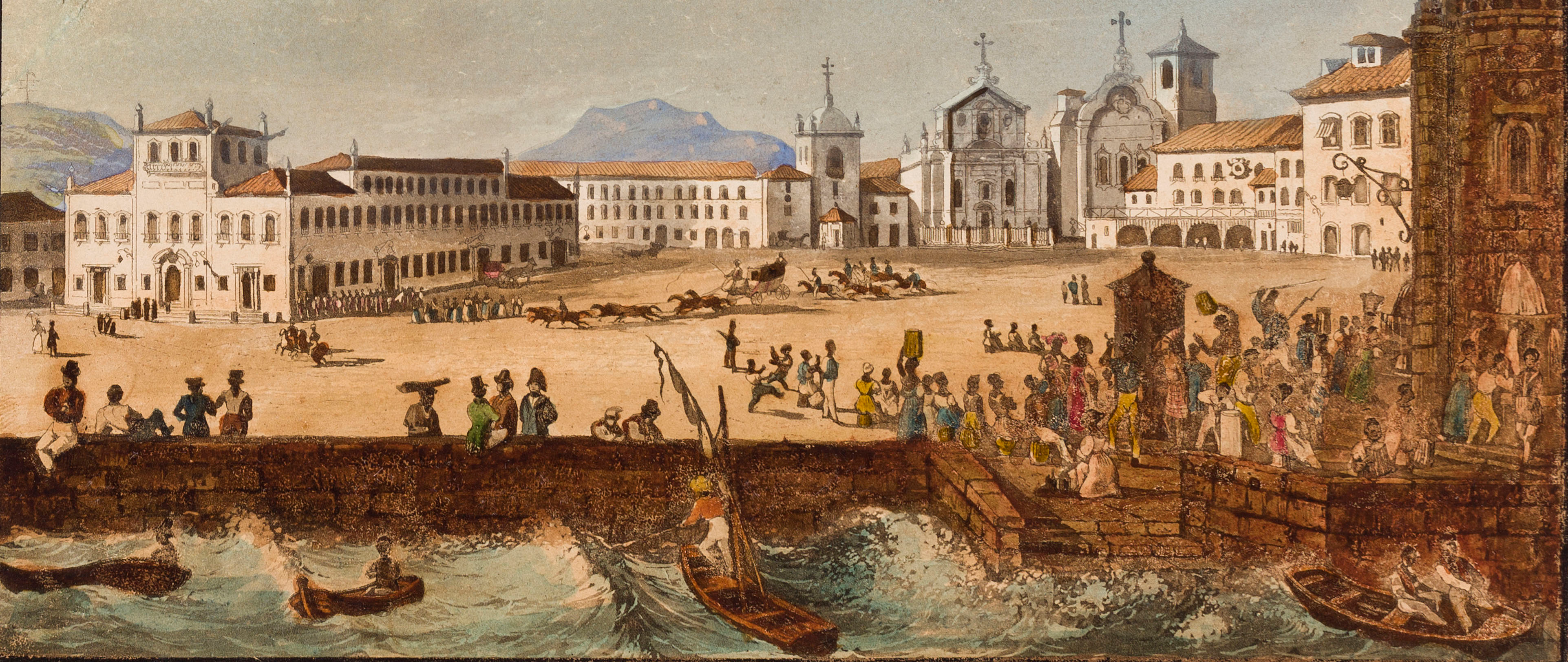
Indigenous people, invaders, colonizers and hundreds of thousands of enslaved Africans arrived over the waters of the Guanabara Bay. During the first centuries of colonization, many enslaved Africans were disembarked next to the square then called Largo do Paço. According to some chroniclers, capoeira in Rio de Janeiro was born here, on the former Piaçaba beach, among the slaves for hire, the dockers, the fishermen and sellers of fish and shellfish.
The land next to the beach was occupied by Carmelite monks and became the square of their monastery. The monks, according to the chronicler Vivaldo Coaracy, had a reputation for being “turbulent, trouble-makers, and unruly”, always provoking the intervention of authorities. For example, they did not allow funeral processions to pass in front of their cloister. They would send their slaves with cudgels to break up the cortege.
The capital of colonial Brazil
The monks bestowed part of the land to the colonial government, which built the governor’s palace on it. The building was finished in 1743, and later became the seat of the viceroys of Brazil. A street market called Quitanda dos Negros was behind that building, where the Tiradentes palace is located today. In that passage black women from the Mina Coast, generally freed, sold their food. Colonial Rio de Janeiro developed from this area, where the harbour, commerce, government and Church converged. Port workers, traders, administrators; enslaved, freed and free people, the nobles and the rabble all lived next to each other and disputed every inch of the square.
The viceroy once complained about the noise coming from the Quitanda, but the black women from the Mina Coast were in possession of their licence issued by the municipal council and managed to remain. In other words, popular groups tried to defend their place in the centre of the city, and the most densely populated space was the Paço Square.
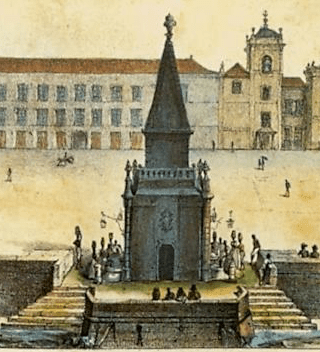
Mestre Valentim’s fountain, as depicted in detail in Debret’s engraving (1839). Collection Museu Histórico Nacional / Ibram.
The pillories (Pelourinho) were another monument that embodied colonial power and justice, standing in the middle of the square during the colonial period (it does no longer exist today). With the migration of the Portuguese Court, in 1808, the palace on the square became the official residence of the king and the Portuguese government. The king, however, preferred to live on the Quinta da Boa Vista estate, quieter and more peaceable, and so did the two Brazilian emperors after him.
The Paço Square constituted an important space of sociability for all inhabitants, described by many travellers and chroniclers. The engraving by Friedrich Salathé (1834), based on a watercolour by his friend Johann Jacob Steinmann, depicts the various social groups occupying the square. Among them, two black boys (moleques) engaged in what seems an acrobatic game, which reminds us of some of the movements of capoeira.
Detail of the engraving
Detail of the engraving
To know more:
Antonio Colchete Filho. Praça XV. Projetos do espaço público. Rio de Janeiro: Sete Letras, 2008.
De los Rios Filho, Alfonso Morales. O Rio de Janeiro Imperial. 2 ed., Rio: Topbooks, 2000 (1 ed. 1946).
Largo do Paço. Gravura de Friedrich Salathé, sobre aquarela de Johann Steinmann. Coleção da Pinacoteca do Estado de São Paulo.
Vivaldo Coaracy. Memórias da Cidade do Rio de Janeiro. Belo Horizonte e São Paulo: Itatiaia e EdUSP, 1988.

