In Rio de Janeiro, the most popular street carnival blocos de embalo in the second half of the 20th century were Cacique de Ramos and Bafo da Onça, which were particularly noted for their capoeira displays on the avenue.
By Juliana Pereira & Matthias Röhrig Assunção.
The blocos de embalo are carnival associations that do not compete in Rio de Janeiro’s official parade of the samba schools. According to Jornal do Brasil, the bloco de embalo “has no annual theme and the aims and criteria are samba and excitement, music, and drums. They are not concerned with costumes and banner”. In Rio de Janeiro, the two most popular and well-known blocos de embalo in the second half of the 20th century were Cacique de Ramos (“The Indian chief from Ramos”, a neighbourhood in the northern zone of the city) and the Bafo da Onça (“Breath of the Jaguar”, located in Catumbi). These two blocos also played a prominent role in the dissemination and display of capoeira in carnival parades.
For Cacique de Ramos, the participation of capoeiristas in the parades probably dates back to the 1960s, though we do not yet have the exact date. For many capoeiristas, carnival was, above all, an occasion to play capoeira in the street, especially in a bloco de embalo, with more freedom, such as Cacique, as stated by M. Burguês:
The parade, no way! During carnival we went to play capoeira. Nobody wanted to parade. Sometimes I paraded in the Cacique de Ramos, in the capoeira ala [“wing” or section of the parading group], which was led by Mestre Mintirinha. […] We played capoeira dressed as Indians. […] Some played berimbau and the others played capoeira. There were thirty, forty capoeiras… That was a wing that Mestre Mintirinha created at Cacique de Ramos, in the [19]70s”
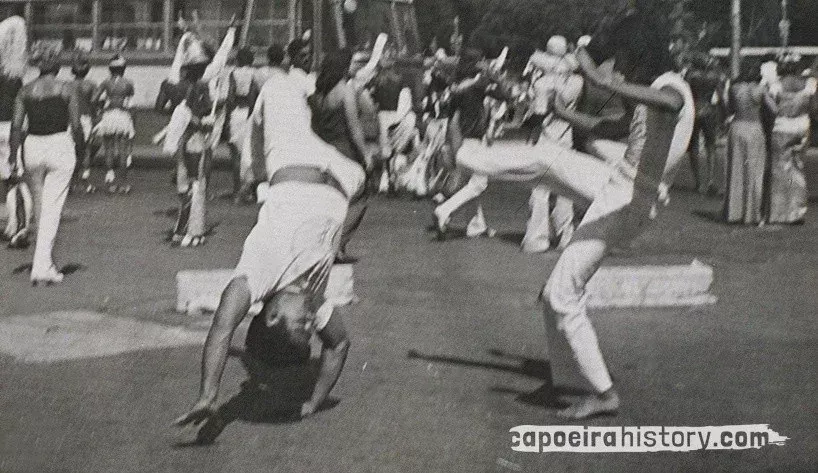
M. Gegê, who also paraded in the capoeira wing of Cacique, remembers that “Mintirinha, Paulão, Touro, Zé Pedro, Luís Malhado and the guys from Bonfim also participated”. According to him, the group dressed up as caciques[= Indian chiefs], with their typicalblack and white Cacique de Ramos costumes. These costumes were offered to them by the bloco, since it was in the interest of the organisation to see them participating in its parade. The recruitment of the members of the wing ended up being more spontaneous: “To be safe, the guy in charge [of the capoeira wing] was the first one there. […] Sometimes we’d pass by and hear him saying ‘Come in, come in here,’ so we’d go in.
Unlike the samba school parades, the bateria of the blocos de embalo took breaks during the parade through the streets of the Centre of Rio. And when the members “rested, we went right into the middle”. They played berimbau, tambourine and capoeira -in other words, the performance in the bloco de embalo was close to a traditional capoeira circle.
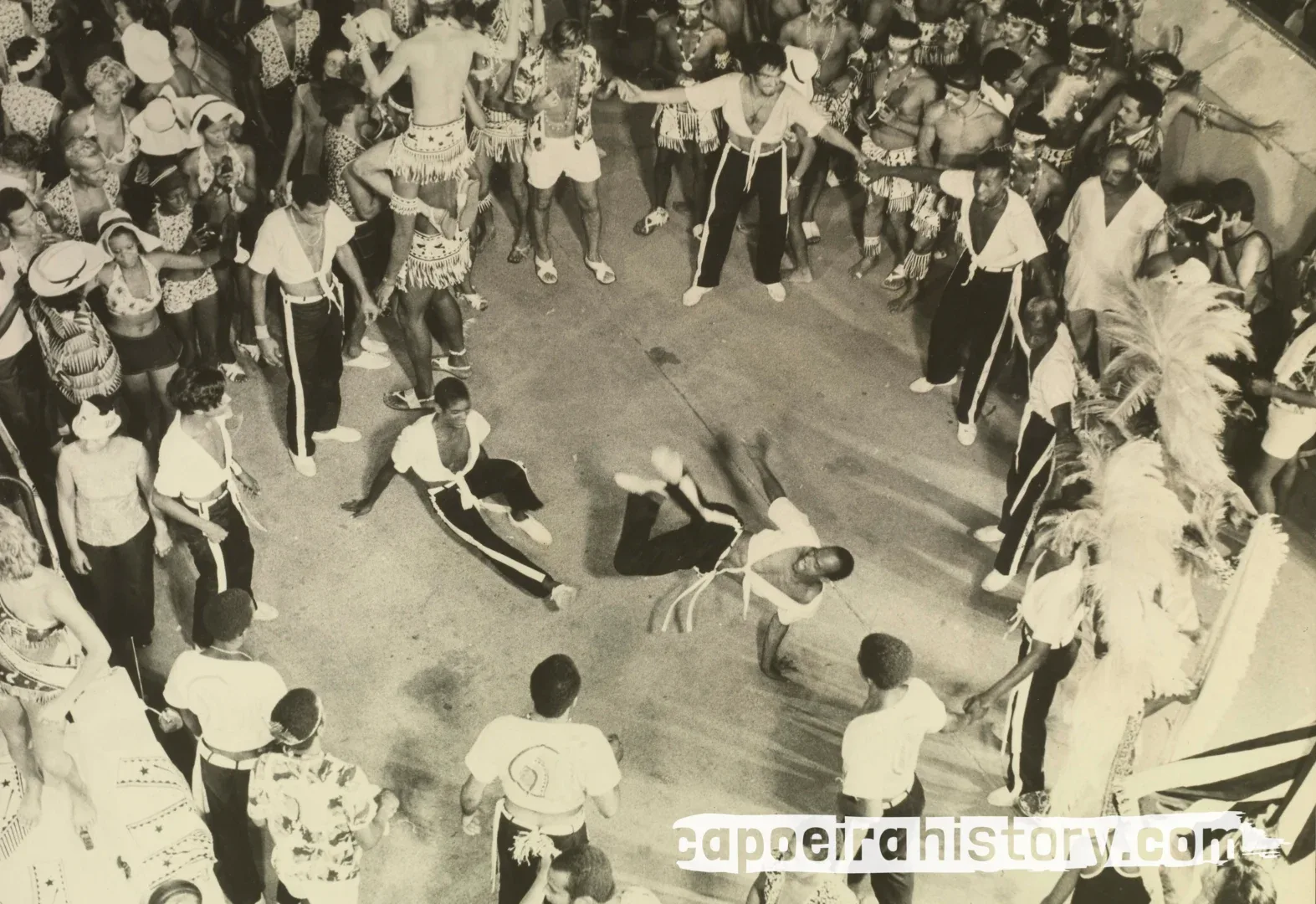
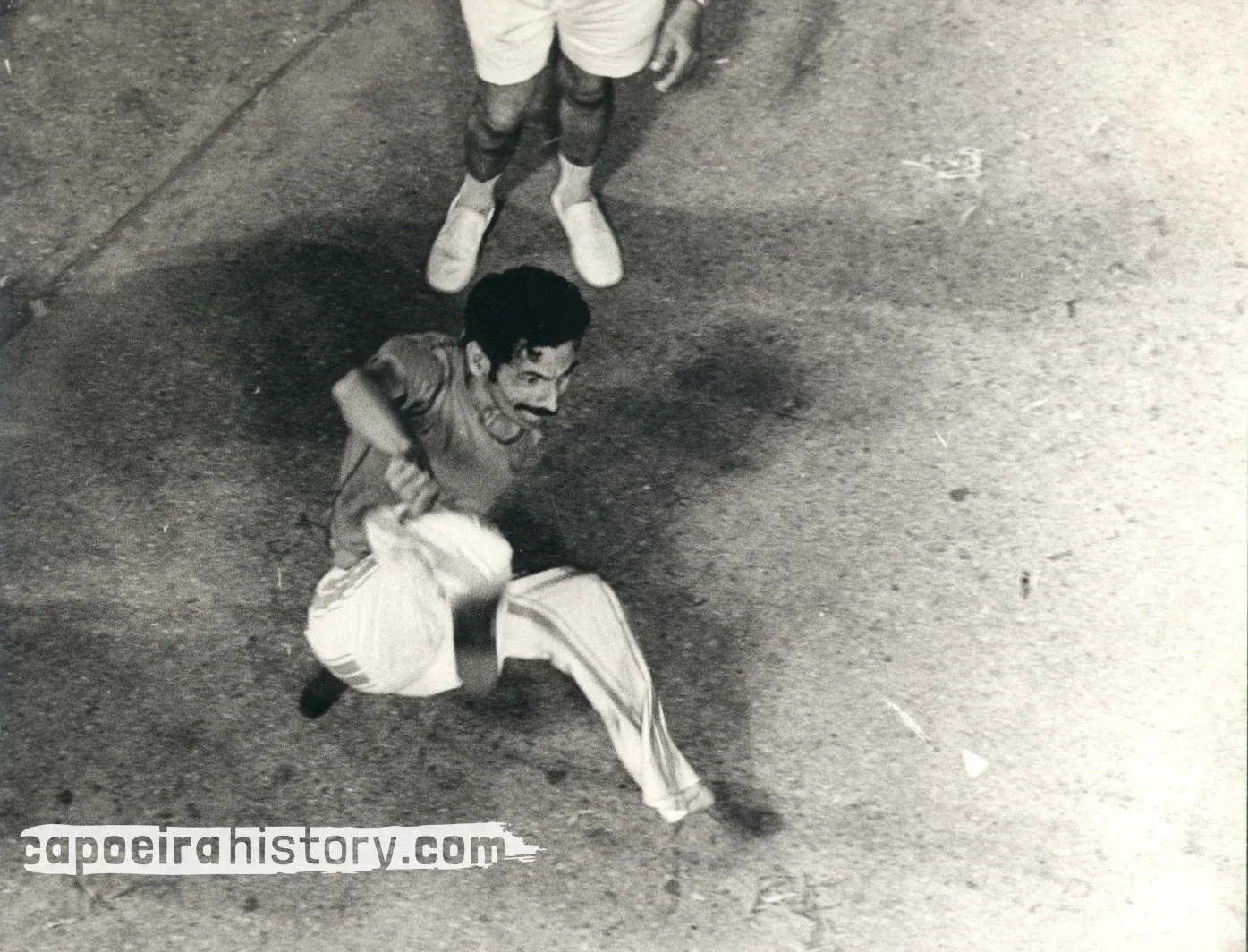
In this photo form Correio da Manhã, a capoeira circle is formed right in the middle of the 1972 Cacique de Ramos parade. Hemeroteca da Biblioteca Nacional collection.
The Bafo da Onça carnival grouphad for the first time a capoeira exhibitionin 1965, in a wing (“ala”) composed of 18 people. The following year, the whole Bafo da Onça had increased the number of its members from threeto fourthousand, distributed in 200 wings. In that year’s parade, “a wing of capoeirasstood out. They”came at the beginning of the bloco, gave true classes of samba and of the traditional artistic fight.” The newspaper Jornal dos Sports is one of the few to provide details about the capoeiristas participating in Bafo da Onça:
In the capoeira sector, they counted on Otácilio, Lemi, Cirílo, Célio and Paulinho. Paulinho and Euclides, besides participating in choreographic capoeira shows, are emeritus fighters, and Euclides recently won the ‘best capoeirista’ contest, deserving the ‘Berimbau de Prata’ trophy”.
According to M. Bebeto, Bafo da Onça’s lead samba singer, Osvaldo Nunes, was also a capoeirista. A pupil of an old-time capoeira, Zé Moleque, he was the leader of the capoeira wing of the bloco. Manchete magazine praised Bafo da Onça’s bateria and the “choreographic audacity of its passistas”. It emphasized that the bloco condensed the best of street carnival: “samba, acrobatics and ballet”.
Bibliography
Assunção, M., & Souza, C. E. (2019). Ginga na Avenida: a capoeira no carnaval carioca (1954-1976). Revista Nordestina de História do Brasil, 2(3), 83-103. https://doi.org/10.17648/2596-0334-v2i3-1491
“Blocos”. Jornal do Brasil, 23 de fevereiro de 1979, p. 46
Capoeira. Carnival. Blocos de embalo. Cacique de Ramos. Bafo da Onça. Rio de Janeiro.