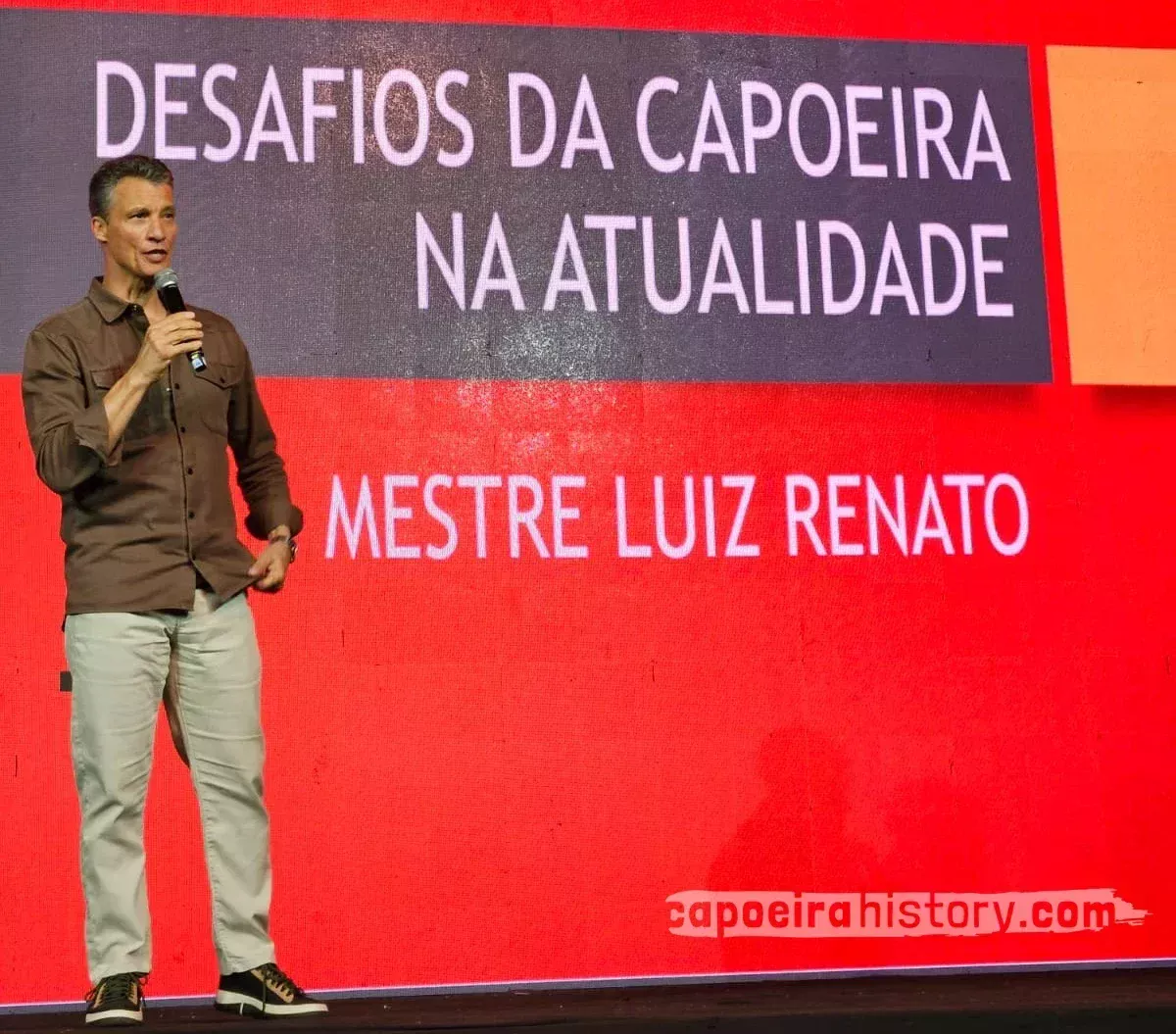
Capoeira and its Contemporary Challenges was a lecture given at the 1st Volta ao Mundo Bambas Científico seminar.
By Master Luiz Renato Vieira.
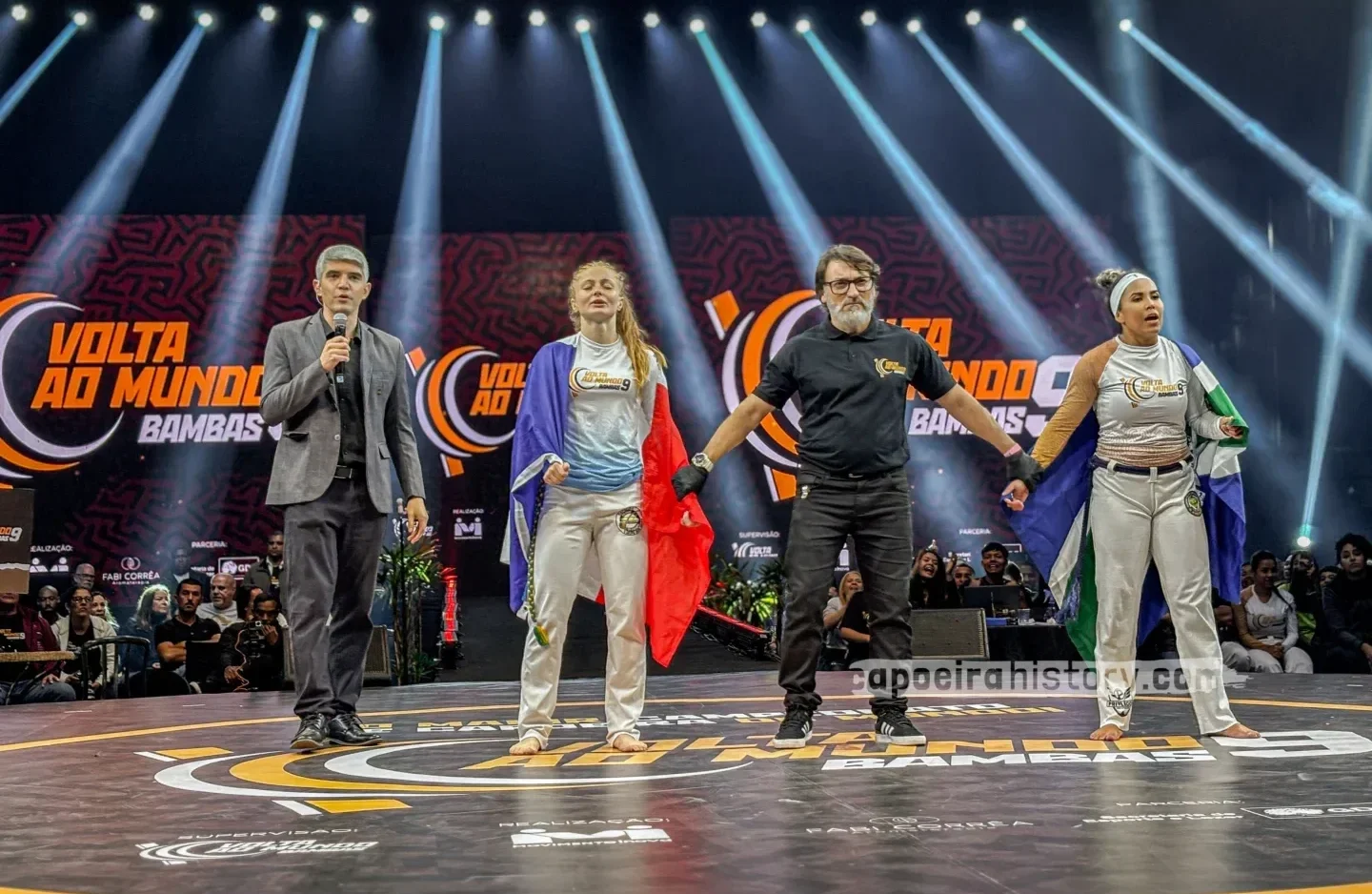
The 1st Volta ao Mundo Bambas Cienífico seminar was held in Brasília, on 25 June 2025, in the context of VMB9 ─ the 9th edition of Volta ao Mundo Bambas.*
The Volta do Mundo – Bambas competition, known as VMB, held its first main edition in August 2022, in Rio de Janeiro, with a unique format that brought judges, high-quality broadcasts and financial awards to capoeira.
Since then, nine editions of VMB have been held up to June 2025, including events such as VMB1 (August 2022, Rio de Janeiro), VMB50K (July 2023, Pão de Açúcar, Rio de Janeiro), VMB4 (January 2024, Olympic arena in Rio with a large audience and live broadcast) , VMB5 (April 2024, São Paulo), VMB6 (July 2024, Los Angeles, first international edition), VMB7 and VMB8 (Brasília, 2024), reaching VMB9 in June 2025, also in Brasília.
The event has achieved global recognition: with qualifiers in Sweden, an international debut in the United States and editions in important Brazilian venues, VMB has established itself as the largest high-performance capoeira competition in the world, energising both the cultural and sporting dimensions of capoeira.
VMB9 –
Women’s Lightweight Awards:
Kitana (champion) and Lili.

Some authors in anthropology talk about lenses that culture constructs, through which we observe the world. Our culture is a lens, and different lenses produce different images based on how we view nature and social relations ─ and capoeira helped me develop this analytical perceptive ability.
Some aspects of what I will try to present here comes from the fact that, as a social scientist with a 40-year career, I am able to detach myself from certain conceptual frameworks and look at the dynamics as a whole, trying to merge historical analysis with the study of the present.
The history of capoeira today, especially when addressing the late 19th and early 20th centuries, has an enormous level of sophistication. Researchers who worked with primary sources, which is archival research, have done wonderful studies. They were able to map out a lot of other detailed information, such as the ethnicity of Africans imprisoned for capoeira in the early 19th century and the weapons they used, or the arrival of Bahians at the Imperial Court of Brazil after 1860, and so on.
Currently, we face challenges that run parallel to this task of searching for primary sources. These are interpretative and analytical challenges, of trying to understand the present time based on this flood of information. We try to understand how this view of history can provide us with reflections on the contemporary world, capable of guiding us towards what we want, because there is no point in studying history, sociology, anthropology, or cultural sciences if it is not to intervene in these realities in an incisive way in the construction of what we desire, which is access to culture, more democratic societies and, speaking of our case, in which we, capoeiristas, share the available information, enriching the tools that capoeira provides us to apply all this knowledge, for example, bringing this wonder that is capoeira to elderly people in an increasingly qualified manner.
This is what information is for: to learn about history, about the tools available and analyse contemporary challenges in an increasingly elaborate, qualified and rich way, bringing us closer to our goals, which we define based on our ethical vision.
We are here organising a competition proposal that adopts international standards of organisational quality, in which athletes have training opportunities and responsible care, and this needs to spread to society. We have goals that we are getting closer to achieving.
At university, when we conduct our research, studies and classes, we are moving in this direction because we have an ethical affinity, an ethical commitment to a vision of capoeira that develops with quality, that seeks participation, the development of concepts and performance. But it also seeks, within the same set of cultural characteristics, space for the elderly, for people with disabilities, for all minority groups, who fight for their identity from a pluralistic perspective.
I believe that work well done in the field of capoeira cannot generate any kind of responsible conclusion that points to standardisation or objectification. Because what is extracted from work well done in a specific sector is the quality and responsibility with which it is done, and not its absolutisation, in our case, the idea of competition crossing all environments of capoeira. Instead, we must turn our attention to the quality of the organisation, responsibility, the right to a voice, the plurality of participants and self-identification ─ people feeling like members, participants, integrated.
Studying history only makes sense when seeking references for the present. It is not about understanding history as the science of the past, but as the science of the future, because from it we have comparative parameters and can adjust our paths towards the goals we have set.
According to Eric Hobsbawm1, the “present time” corresponds to the period in which ongoing events force historians to re-evaluate the way they interpret the past. This means that contemporary events impose a revision of historical perspectives, chronological classifications and previously established narratives, since it is only in the light of current transformations that the past acquires new meanings and relevance.
1 Eric J. Hobsbawm, “Un historien et son temps présent”. In Institut d’Histoire du Temps Présent. Ecrire l’histoire du temps présent. Paris: CNRS Ed., 1993.


A brief overview and periodisation of the history of capoeira
Contempt and Persecution
There was a long initial period starting at the end of the colonial era and during the Brazilian Empire in which the first manifestations of what we now call capoeira can be identified. From the outset, these manifestations stirred contempt among the elites for the cultural expressions of the black diaspora, as well as the first repressive actions by the state, mainly in Rio de Janeiro.
Then, persecution intensified, especially at the beginning of the Republic, when a new model of society was imposed. Brazil then began to reject its role as the world’s largest slave-owning country, with a huge black population outside Africa, the country that had the longest period of modern slavery in the world, the country to which the largest number of enslaved Africans in the world were transported. After Abolition and, soon after the Proclamation of the Republic, the country sought to see itself as a Europeanised country, to the point of trying to resolve issues related to the labour market, settlement of the countryside and agrarian development by welcoming European immigrants, even with the huge contingent of a formerly enslaved population available. This was a workforce that the country refused to accept because it represented integration, and the logic of slavery in Brazil was never about integration, it was about exploitation.
The persecution of capoeira in a way symbolised the actions of the emerging republican power towards modernity and the quest to extinguish and eradicate symbols of slave-owning Brazil. Brazil did not accept itself historically, it did not come to terms with its history, and persecuting capoeira was a way of fighting against this past in the worst possible way, repressing an extremely recent past. This persecution was brutal and is the most documented period in the history of capoeira, because one thing that the contemporary world does very well is the organisation of the police state: while violence persists in a police state, there are records of violence. The main records that capoeira provided during this period are those referring to arrests and violent acts in cities, mainly in the city of Rio de Janeiro.
Depending on the city, this period extends from the last decade of the 19th century to the mid-1930s. In Rio de Janeiro, it was approximately until the mid-1920s when there were no more arrests for capoeira, although the law was still in force, which was only definitively changed in 1941 with the new Penal Code. Elsewhere, this happened in a slightly different way.
Autonomous construction
As the repressive fervour cooled, a period began that I have called autonomous construction. This was a time when the state was no longer acting so violently in its attempts to eradicate capoeira, but neither was there any form of recognition (although we did find isolated instances of recognition, but not in a systematic way).
What we have from the 1930s to the 1940s and 50s – with the specific exception of the movement that took place in Salvador, with Mestre Bimba and Mestre Pastinha – are selective interpretations of capoeira fighting. Attempts to develop martial arts methods and fighting styles based on capoeira.
We have capoeira without berimbau, the records of Mário Aleixo, those of Aníbal Burlamaqui, which are various proposals for systematising capoeira fighting. It is as if they sought to extract from the art form—with all its complexity, including fighting, games, dance, and music—only specific elements of fighting, but fighting as self-defence (not necessarily fighting in a sporting format, which could be trained, promote health, and provide competitions).
Government support
Starting in the 1970s and 80s, capoeira began to expand, both nationally and internationally, reaching many regions within a few years of each other: it spread to the United States and entered Europe via Portugal, always following the direction of migratory flows, which is the flow of money and job opportunities. This was the logic behind the expansion of capoeira, until the last frontiers were, curiously, Latin America and, more recently, Africa.
Today, some frontiers of capoeira’s international expansion are in Latin America, with countries where capoeira still has much room to grow, and in Africa. In Asia, it expanded long ago and is very strong. This phenomenon of capoeira as a global popular culture is a concrete development that gives us much to reflect on, because this movement happened as an autonomous construction of capoeiristas.
Analyzing the expansion of Eastern martial arts, the way they grew and spread throughout the world, it is clear that, in many cases, they were government projects. In the case of judo, this is explicit. Judo is a construction based on traditional fighting styles that, through a government initiative, emerged as a fighting style to provide educational elements and safe competitions.
In the case of capoeira, it emerged in a multifocal manner, based on references from the actors involved in the expansion of capoeira around the world, which were the groups and the masters. That is why we face many dilemmas today in the expansion of capoeira, which are difficult to resolve if we do not take into account its growth model. The variety of grading systems in capoeira, for example, is a consequence of this model of expansion, and it is up to the history of capoeira to show that, regionally and collectively, the grades, as well as the names, the terminology used, the taxonomy, the way of classifying the moves, and the way we call them, are part of identities that are local identities and group identities. In other words, as regional identities, they are not just a list of names or a sequence of graduation strings (cordéis), but have to do with the history of that segment. The idea is that it is not just a matter of standardizing or creating a universal model, as if it were a kind of “Esperanto of capoeira.” This is a very dangerous illusion because it disregards the identity foundations of the communities that organized capoeira. In fact, in some cases, it would be better to say capoeiras.
Government support for capoeira emerged at a very specific moment and has a date of birth. The first systematic public policy organized in Brazil took place in 2004 and was expressed in this speech by the then Minister of Culture, Gilberto Gil, in Geneva, on August 19, 2004: “Capoeira is an existential affirmation of black people in the context of slavery, racism, and domination, present at various moments in Brazilian society. The history of black people in the diaspora is reflected in the game of gingas and the mandala of the capoeira circle.”2
We will consider Minister Gil’s speech as a kind of birth certificate for public policies at the Brazilian federal level for capoeira. It is the first time that it has been elevated to the status of a federal policy issue in a systematic and lasting manner.
2 GIL, Gilberto. Speech in honor of Sérgio Vieira Mello. Genebra, 2004. Avaiable at <http://www2.cultura.gov.br/site/2004/08/19/ministro-da-cultura-gilberto-gil-na-homenagem-a-sergio-vieira-de-mello/>.
Intangible heritage and safeguarding
Over the following years, a very complex organizational process was developed, taking three locations as a reference—Rio de Janeiro, Salvador, and Recife—and some challenges arose for its registration as intangible heritage. The registration of an intangible cultural asset leads to the next step, which are safeguarding measures. This is not a mere scientific curiosity or a symbolic act by the State; it has a very well-established purpose: the registration of the intangible cultural heritage of those assets that society chooses as priorities for public preservation policies. This preservation is called safeguarding, with a specific presentation and peculiarities that follow internationally defined parameters.
Safeguarding values the manifestation with a bias towards valuing the bearers. This is a very different idea from traditional cultural appreciation based on museum exhibitions or educational content. Here we have the idea of living culture, different from cultural policy that promotes popular culture as an exotic asset.
By promoting the registration of an intangible cultural asset, the intention is that the producer of the asset will be able to make a living from that activity, because in this way everything will be preserved. When considering the activity, several circumstances are identified that move with history and need to be addressed, such as legal, environmental, health, and economic issues, and it is then necessary to find ways to reconcile them. One example is the pottery makers of Goiabeiras, who need to maintain their traditional craft, but there is a serious problem of pollution in the river that supplies the clay used to make the pots. In other words, there is an environmental problem that needs to be discussed alongside the cultural issue, because safeguarding policies cut across, they are transversal. In the case of capoeira, this manifests itself in the discussion of the issue of professionalization. What safeguarding does is seek to maintain the people who keep the culture alive and active, not only so that this culture is available as a reminder of the past, but so that it continues to change. Ensuring diversity means working with quality and doing things very well to ensure that masters can make a living from their craft. This is a team effort in which everyone needs to be involved.
When we say that safeguarding policies are transversal, we are drawing attention to the fact that specific actions are not the only thing needed to promote capoeira. Capoeira gains much more when it participates in collective actions in mainstream society, that is, when the seed of capoeira is planted in schools or in health projects for the elderly in primary and basic health care, for example.
We need to go beyond policies restricted to projects and public tenders, because there is an important asset in the world of capoeira called diversity. It is much more interesting for capoeira to coexist with dozens of other forms of expression, all of which have the same power. This is a dream for us capoeiristas: that capoeira competitions be a great spectacle, but that the cultural activities of capoeira be other great spectacles. This is the place that capoeira deserves to occupy, because it is a place that preserves this important asset, which is diversity.
The sportification, competitions, and social navigation of capoeira
I like a theoretical concept that I am trying to develop and bring to the field of capoeira: it is the idea of social navigation, used by a Brazilian anthropologist named Roberto da Mata. It explains a lot about Brazil and how capoeira survived and exists today with the strength it has. It is the fact that it manages, not through some mystical characteristic, but through its complexity and cultural richness, to adapt to completely different environments and survive these transformations. For example, what Mestre Bimba did is a fantastic exercise in social navigation. It was the first major effort to adapt capoeira, mainly from an ethical, technical, and pedagogical standpoint, to the parameters of the urban middle class, in his case, in Salvador. This adjustment he made, starting in 1928, gave regional capoeira the dimension it needed to explode as a cultural phenomenon in the world. Mestre Bimba did something, seemingly trivial today, which was to package capoeira. He organized a sequence of eight steps, with a system in which, based on that learning, it is possible to teach capoeira classes. You don’t need to be an expert capoeirista, nor do you need to be highly skilled; you just need to memorize those sequences and, without any other pedagogical foundation, you can teach a capoeira class, and a beautiful class at that!
Many Eastern martial arts also have this, long before capoeira: this ability to translate codes and languages, breaking through social barriers and bringing segments that previously felt excluded into a cultural manifestation. Mestre Bimba was a genius at social navigation.
With Sinhozinho (1891-1962), we have one of the most interesting efforts to martialize capoeira, a translation of capoeira into a language of self-defense, found in Burlamaqui’s book.
Another way of promoting social navigation occurred with Mestre Pastinha, who responded to another demand from a segment that sought political engagement. At his academy, he welcomed Jean-Paul Sartre and Simone de Beauvoir. He was very close to Mário Cravo and Jorge Amado. He wanted to navigate other paths and in fact did so, leaving his work systematized. Pastinha was a figure whose skill as a capoeirista no one disputes, whether he was a great mandingueiro, a great capoeirista, or not, because the work to which he dedicated himself was another, it was the consecration of capoeira as a cultural manifestation, as a proposal to strengthen popular cultural identities. A path quite different from that proposed by Mestre Bimba, but equally important from the point of view of building what we have today.
What I am doing here – which I have called the history of the present – is starting from the challenges we face today, looking at the past and trying to identify what these masters did to build the reality we have today.
As we are dealing with competition, there is a specific case that I cannot fail to mention: the famous case of Ciríaco. In the 1910s and 1920s, martial arts arrived in Brazil with great force. There are several records of Japanese fighters circulating throughout Brazil. In fact, in Rio de Janeiro at that time, the Navy had adopted jiu-jitsu as a form of combat training. However, during the same period, many Brazilian intellectuals, writers, and journalists were already engaged in an intense debate on the issue of national identity, while capoeira was gradually emerging from the shadows of criminality. Capoeira was beginning to arouse interest in its sporting and martial potential (but not yet its educational potential). The Navy’s choice of jiu-jitsu as a martial art for training its military personnel triggered a flood of criticism from many newspapers. Shortly thereafter, in 1909, a Japanese fighter who had been excelling in challenges, which were very common in Brazil, fought Ciríaco, who surprisingly won the fight with a single blow. This fight had a major impact.
This event contributed greatly to the process of reinterpreting capoeira. As at that time there was still a law in force that punished the practice of capoeira in streets and public squares, the event was held indoors, which circumvented the possibility of punishment. This shows that great care must be taken when talking about the repression of capoeira at that time. Most likely, repression was more associated with sociocultural and ethnic profiles, becoming much more a persecution based on racism than on the cultural manifestation itself, when practised in other contexts.
Dilemmas of institutionalisation
We are talking about a broader process, which can be called the institutionalisation of capoeira. We have many challenges ahead of us, and holding good capoeira competitions is just one of them. Discussing the issue of regulation, what the limits are, what points only the capoeira master can deal with, but also debating what notions of capoeira a physical education teacher can teach at school and, in this way, contribute to the capoeira master later having a student who is interested and wants to develop their knowledge. Does this basic literacy in capoeira necessarily have to be provided by the capoeira master?
Today, we have a scenario that inserts capoeira into a complex society, unlike what happened in its origins, when it was practised by an ethnically well-defined and socially excluded segment. Currently, capoeira is transversal and appears in all sociocultural and economic contexts. Capoeira today presents a much greater level of diversity than could have been imagined 50 years ago. Being open to thinking about capoeira in the context of diversity is very important for dealing with these dilemmas. This has never been more necessary, because otherwise we run the risk of developing exclusionary views that do not correspond to reality. Developing a restrictive perception only leads us to miss opportunities, because there is no way to control the development of capoeira, and it will continue to be rich and diverse.
For a long time, internationalisation was the highlight of capoeira, its expansion abroad. Now, that moment is almost over. We are living in a moment in which, based on the experiences of capoeira’s previous expansion, we have refined different perspectives on the capoeira we practise in Brazil ─ once again, the history of the present. These expanded experiences abroad have greatly helped the development of capoeira in the contemporary world.
We have a very interesting debate today in the legislative branch, and my recommendation is that capoeiristas participate directly and seek information. I am a capoeirista, I am a capoeira master, I am a civil servant in the Federal Senate, where I work as a legislative consultant, specialising in the discussion of proposals, and I see the movements happening. And, looking at the process of organising capoeira from this perspective, I am very clear about one thing: each of us needs to know how things work and build our own conception. Responsibilities cannot simply be delegated to the State; effective autonomous mobilisation of groups and other entities is necessary.
Bringing the debate into the context of the competition event, we have to understand the place and possibilities that capoeira competitions have in the contemporary context, going beyond the factual dimension of the spectacle, of who won or who lost, of how many views will be achieved on YouTube. It is about understanding how this fits into a complex grammar, together with other fields of capoeira, which also need this development and equally demand quality, organisation, and professionalism.
The author
Luiz Renato Vieira is a capoeira master from the Beribazu group, founded by master Zulu, and a capoeira teacher at the University of Brasília. He also holds a master’s degree and doctorate in cultural sociology, with postdoctoral studies in comparative history.
He is the author of the books O jogo da capoeira: corpo e cultura popular no Brasil [The Game of Capoeira: Body and Popular Culture in Brazil], (Rio de Janeiro: Sprint, 1995) and A capoeira e as políticas de salvaguarda do patrimônio imaterial [Capoeira and Policies for Safeguarding Intangible Heritage], (Brasília: Fundação Cultural Palmares, 2012),, as well as several articles on the subject. He was a consultant to the National Institute of Historic and Artistic Heritage (IPHAN) during the process of registering capoeira as intangible cultural heritage (2008) and a speaker at the meetings of the Capoeira Viva project, organised by the Ministry of Culture (2010). Since 2003, he has been a Legislative Consultant to the Federal Senate in Brasília, working in the areas of social assistance, minorities, sport, culture and public statements.